Somewhere between the third reel and the fourth open tab, I noticed my attention had gone soft. So I went looking for the opposite: something that sits you across from real people and makes you actually remember things. It turned out to be a small box of cards called Nana.
This is the one I landed on, and how it plays, start to finish.
Why a card game, why now
For a while my go-to was Exploding Kittens. I mostly played it with the younger guys at work, and on weekends over coffee with friends. We’d be doubled over laughing at a card that blew someone up, or a last-second reversal that flipped the whole game. That kind of energy is real in a way no screen can fake. Everyone puts work down for a bit, and the laughing is the good, loud kind.
It also pulled me off a bad habit. I used to kill my downtime scrolling short videos that gave me nothing, until my head sat in that “full but tired” state. So after a while I wanted something else: the same laughing-together feeling, but with more to chew on. A game that made my brain focus and remember instead of just riding on luck.
Finding Nana
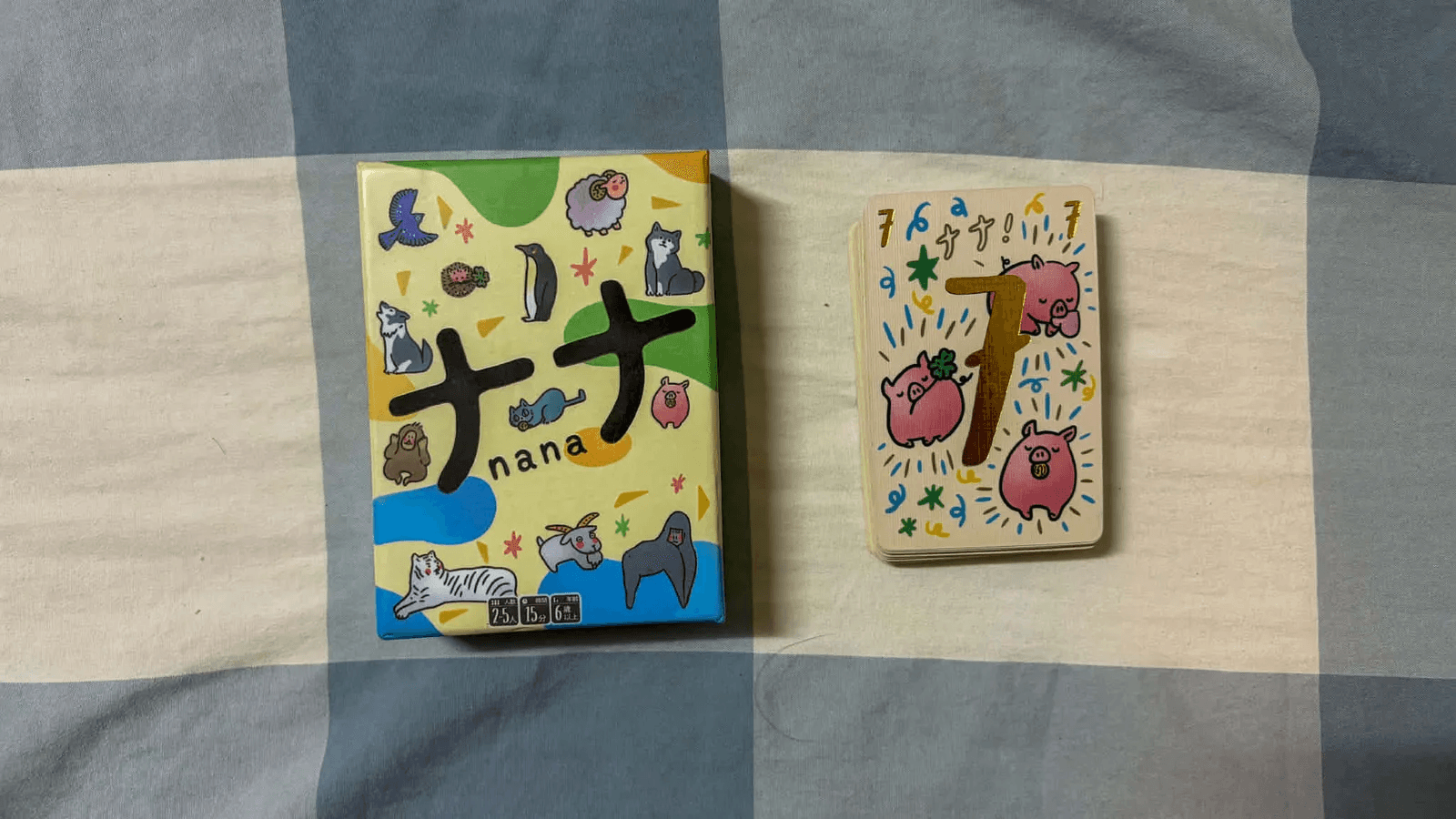
I found it almost by accident, scrolling Shopee. The art caught me first: cute, colourful, slightly oddball little animals. The ratings were high and the rules looked simple, so I picked it up. Then came the detail that sealed it: nana (ナナ / 七) literally means seven in Japanese, and seven turns out to be the game’s lucky number.
A bit of background: Nana is a memory-and-deduction game by Kaya Miyano (art by Sai Beppu). The Japanese printing is hard to find abroad, so it was reissued for Western shelves as Trio. If you’ve seen “Trio,” it’s the same game.
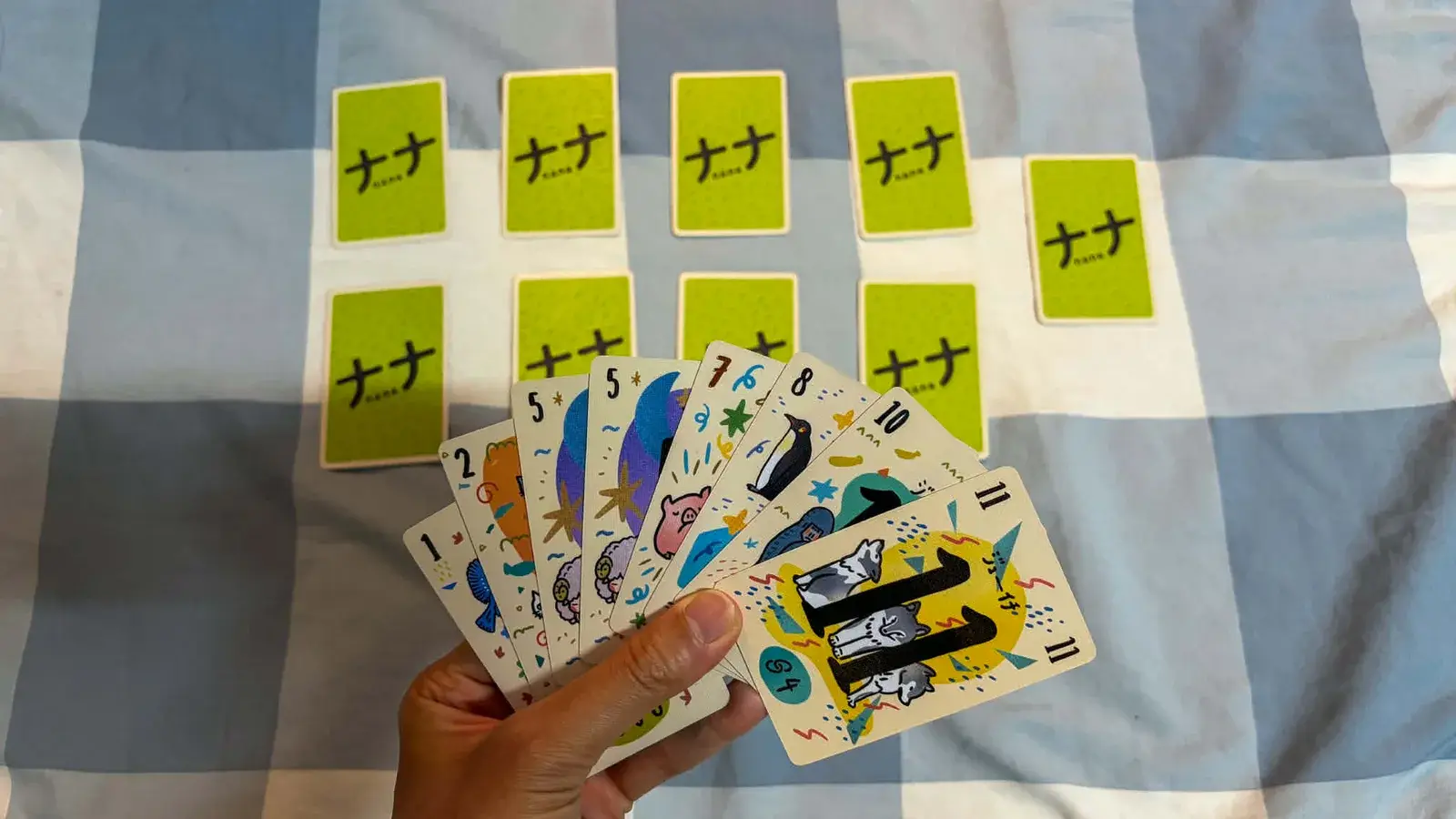
When the Shopee package showed up, the box surprised me. It’s tiny, small enough to sit in your palm. But the moment I picked up the cards I was hooked, starting with the feel of the stock. The art is that plain, minimal style, hand-drawn animals that look a bit weird and a bit cute at once, very Japanese. The printing is lovely too: the cards have a textured, slightly raised finish you can feel, and the sevens are done in a glossy foil that looks great. My first game was with a coworker. The two of us just fumbled through it, reading the rules as we played and flipping the wrong cards over and over.
I already wrote a 30-second first-look in the Stream; this post is the full version. I picked mine up on Shopee.
What you’re trying to do
Nana is for 2–5 players, runs about 15 minutes, and plays from age 6. The whole game chases one goal: reveal three cards of the same value, a trio. Bank the right trios and you win. Everything below is just texture around that one idea.
What’s in the box
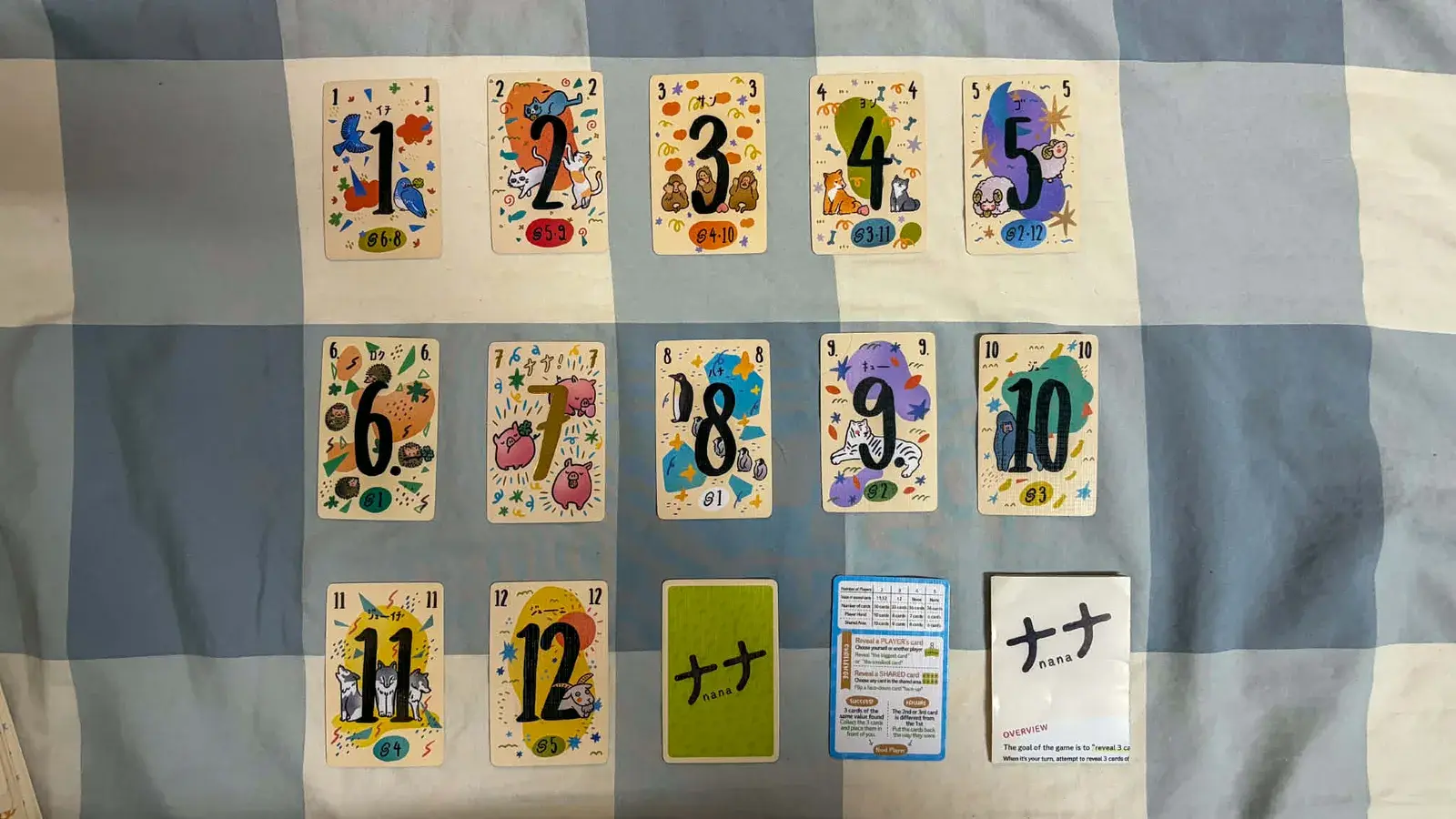
- 36 number cards: values 1–12, three copies of each.
- 1 manual (Japanese and English).
The backs are a plain green stamped with ナナ; each front pairs a big number with a hand-drawn animal and a small hint number in the corner (that hint matters for one of the win conditions, below).
Setup
Deal depends on the player count. Some high cards sit out so the maths still works:
Then three small rules that shape everything:
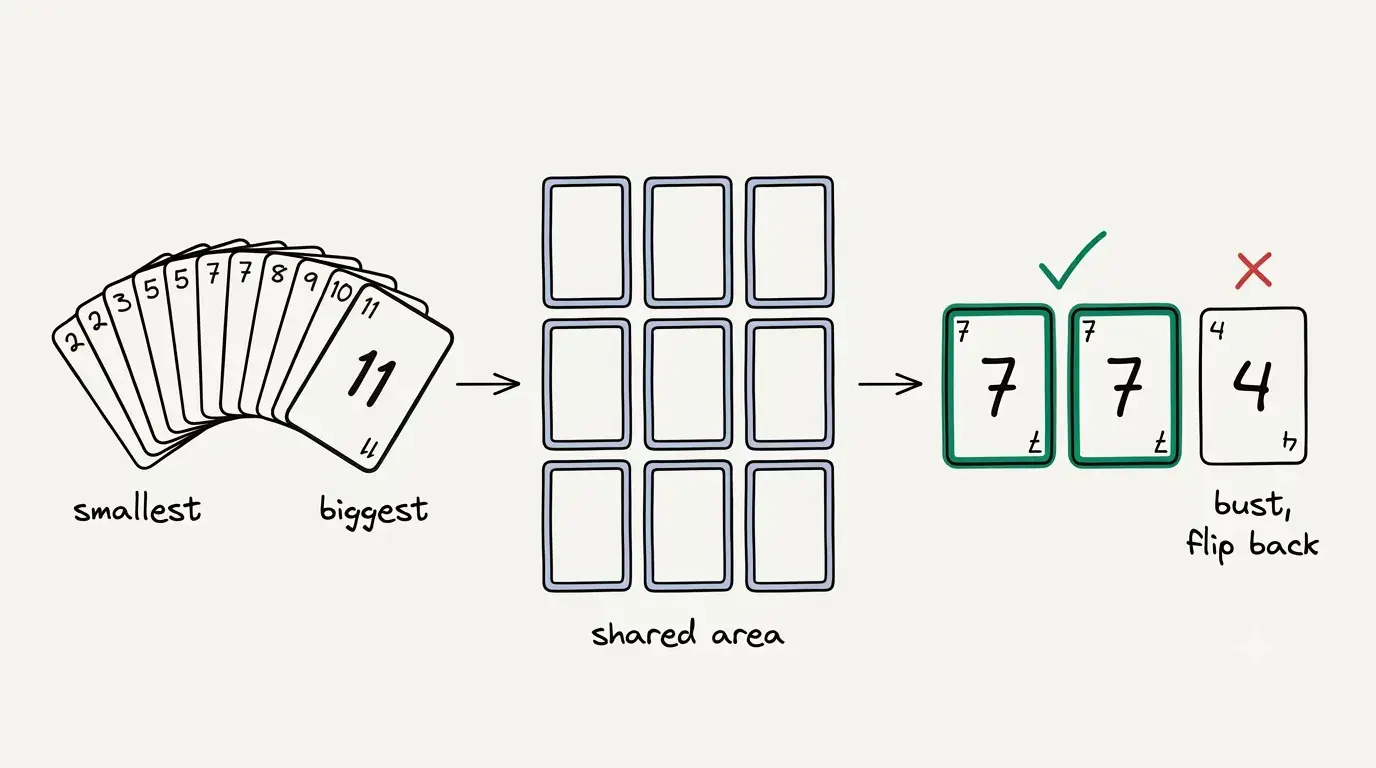
- Lay the shared cards face-down in a neat grid in the middle. You’ll be trying to remember which slot was which, so tidy rows help.
- Sort your hand low to high, and you may only ever reveal the cards at the two ends (your current smallest or biggest). This is the rule the whole game pivots on.
- Whoever had something lucky happen to them recently goes first. If nobody can decide, pick any way you like.
You can play with anywhere from two to five, but I think three or four is the sweet spot. Don’t overthink who goes first: rock-paper-scissors, lady first, whatever gets you playing fastest.
About that grid in the middle. I have a mild obsession with lining it up: the face-down cards have to sit dead straight, even gaps on every side, like a proper flexbox layout. It’s not pure fussiness, it helps you remember positions, so when a card gets flipped and put back it goes back in the exact same spot. As for your hand, low to high feels most natural to me, but it’s optional. All that really matters is that your smallest and biggest cards are on the ends; arrange the middle however you like.
How to play
Turns go clockwise. On your turn you go for a trio by repeatedly taking one of two actions:
- Reveal a card in someone’s hand: pick any player, including yourself, and reveal their biggest or smallest card. Set it face-up in front of its owner for now.
- Reveal a card in the shared grid: flip any face-down card in the middle.
Your first reveal sets the target value, and every reveal after it has to match:
- Flip a card with a different value and the challenge fails on the spot: hand cards go back to their owners, shared cards flip back face-down.
- Flip three of the same value and you succeed: take those three as a set in front of you. Then play passes on.
That loop is why it’s a memory game. Every card that gets revealed and then hidden again is information (who held the 9, which slot was a 4), and whoever tracks it best cleans up.
How the game ends
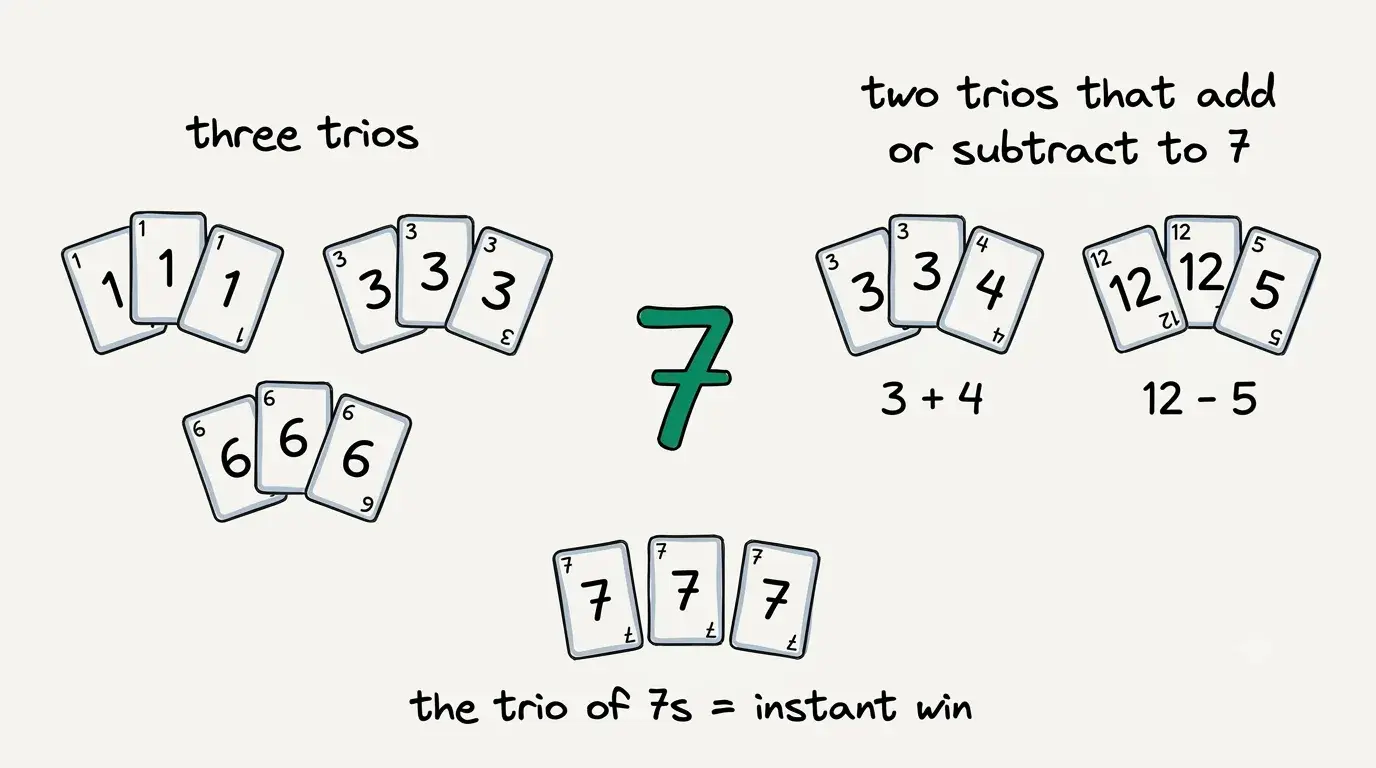
You win the moment you hit any one of these:
- Bank three trios, or
- Bank two trios whose values add or subtract to 7 (say a trio of 3 and a trio of 4, or 12 and 5, since 12 − 5 = 7), or
- Bank the trio of 7s, which is an instant win.
Strategy and tips
A few things I’ve picked up after a bunch of rounds, mostly playing two-player. It’s not a pure memory game. For me it’s about half remembering and half reading the other person, and with two players, every exposed card is worth a lot.
- Pick your targets early. Aim for a pair that wins fast: a 3 and a 4, a 2 and a 5, a 1 and a 6, or just the sevens. Don’t collect random trios, decide from the start which two numbers you’re chasing.
- Read their hand. On their turn, watch which end they flip and where they hesitate. If someone keeps flipping high cards, they probably need a big number. My partner, for one, is terrible at hiding it. 😄
- Attack, don’t defend. Once you know they need a certain value, flip their low or high card to force it into the open. And break their combos: if they’ve already banked a trio of 3s, don’t let them get the 4s.
- Mind your hand size. The fewer cards you’re holding, the easier you are to read. When you’re down to four or five, hide your intent by flipping the shared grid instead of your own hand.
- Bluff a little. Sometimes flip a shared card you know won’t match, just to reset the read and keep them from clocking your pattern.
- Remember the grid, not just the cards. The shared slots are positional memory, and whoever remembers where the 4 went wins the race to it.
- Play the sevens on purpose. Since seven ends the game, the trio of 7s and any pair that adds or subtracts to seven beat chasing a plain third trio.
FAQ
Straight from the manual, the questions that actually come up:
- Can I reveal from the same person twice in a row? Yes. Same goes for revealing your own cards.
- I was dealt three of the same value, can I just score them? Yes, if they’re the biggest or smallest in your hand. Lucky you.
- It feels weird to start holding a complete trio. You can re-deal if you like. If you still end up with three of a kind, just play it.
Why it sticks
What keeps Nana on the table is how much it does with so little. Thirty-six cards, one rule about the ends, fifteen minutes, and still every round is a small workout for memory and nerve. It’s light enough for family and a partner, and mean enough to stay interesting once everyone is paying attention.
For the price of a couple of coffees, Nana beat everything I expected of it.
It brings the good stuff: real fun, actual laughing, and those tense little moments when you’re digging to remember where a card was or trying to read what someone’s about to do. A small game, but a complete one. It gives my memory a workout, and it gives me a reason to sit across from friends and family instead of a screen. That’s plenty.